

Showing posts with label Society. Show all posts
Showing posts with label Society. Show all posts


Una Noche de Salvacion y Curacion
>> 30 November 2009
Dios misericordioso, salves nuestra tierra filipina! En este año, me duele ver lo que paso.
La Tercera Convencion Nacional de G12: Linea Real
>> 29 November 2009
Yo iba a la tercera convencion nacional de la vision G12 en Manila desde 26 hasta 28 de noviembre 2009. Hay mucha gente! Muchisima! Estoy en que hay mas de 8,000 participantes estaban alla.. Me alegro que yo saliera ganando tras la convencion. El Pastor Cesar Castellanos no estaba alla pero en aquel momento yo recibia muchas cosas buenas del Señor. El billete de ida y vuelta era demasiado caro. No importa cuanto vale pero era lo mejor.


 Read more...
Las Palabras del Presidente Manuel Luis Quezon y Molina
>> 21 November 2009
Words of the great President Manuel Quezon in English and Spanish for the Filipino people and the former colonial master, the Yankees. It was said he learned English in just 18 days! Claro M. Recto learned it in 3 months. Both were hispanoparlantes. The English language was so foreign during their time since only the Filipino dialects and Spanish were widely spoken and understood by the majority. Among the Filipino dialects, he adopted Tagalog as the basis of the country's national language while Spanish and English were given importance and were official in the land. He is known as 'Father of the National Language.' The last hispanoparlante in the family died 13 years ago. My generation will learn it otra vez (again) and will love the country more... ☺
I would rather have a country run like hell by Filipinos than a country run like heaven by the Americans, because however bad a Filipino government might be, it can always be improved.
— Pres. Manuel Luis Quezon M. (August 19, 1878 — August 1, 1944)
La Guerra de Las Flores
>> 11 November 2009


Waling-Waling (Euanthe sanderiana, top) or Sampaguita (Jasminum sambac, bottom)? There had been a motion to replace Sampaguita as the Philippines' national flower in 2004. FYI, it was adopted as its national flower back in 1937. ☺
Sampaguita photo courtesy of: http://www.philippine-culture-club.eu/
Read more...
Sampaguita photo courtesy of: http://www.philippine-culture-club.eu/


El Día de La Hispanidad
>> 11 October 2009

I won't be blogging in Spanish for the angloparlantes. =P Today, October 12, the entire Indias is celebrating El Día de La Hispanidad o El Dia de La Raza (Columbus Day) and the Feast of Pilar which is celebrated in the Hispanized city of Zamboanga and some other cities and municipalities here in the Philippines. The Virgin of Pilar was said to be the patron saint of the Hispanic peoples. Why should Filipinos commemorate such celebration? According to history, this is the day when Cristobal Colón (Christopher Columbus) found the Indies at the dawn of the Age of European Exploration.
It was said that 9 months after the discovery of Hispaniola (now, Haiti and Dominican Republic) the first latinoamericano was born from the intermingling of the Indian Natives and Europeans. West Indies or East Indies, the natives were called Indios. The West Indies was the Americas while the East Indies, the Asia-Pacific region and some parts of Asia. Columbus never reached the Philippines we can't argue that. But because of the discovery of the West Indies that drove the exploration of the East Indies where geographically, the Philippines, the Spice Islands and Marianas were found.
There are a lot of disputes and ramifications about commemorating this celebration but in my opinion there's nothing we can do about it. It's history and we can't change it. We should be thankful for the rich culture, shared history and beautiful genetic stock, a bitter-sweet legacy of October the 12th thereafter. I believe the Pre-American Filipino commemorated this celebration. I found a chromolithographicized photo of a headless statue of Columbus at the height of the Philippine-American War. The caption said that the Filipinos vandalized the statue but I believe it was an act done to maneuver the colonial plans of a new imperialist. I'm not sure where it was taken really but I found this in an archive about Old Philippines in Facebook.

Catchy Night Shots
>> 08 October 2009


Night shots are really difficult to handle. Catchy. It'll be great to hear some of your tips or experience on taking night shots. I'm using an entry-level DSLR cam by the way. ☺
Read more...
Cumbira Nasad!


Comimos otra vez! Nuestro consejero gusta comer mucho. Pienso que él es demasiado pesado ahora. Él tiene que tomar una decisión para ese asunto. Jeje.
Read more...
3rd RELOAD CAFÉ
>> 06 October 2009

My mentor's ingenuity by using nothing but scrap. Everyone loved it! I hope to see it on the next cycle. ☺
Read more...
¡Qué Bonita Bandera!
>> 30 September 2009

Issues about adding an extra ray of the sun came up a couple of weeks ago and it really raised my brow not because I was biased but it's inappropriate and unnecessary. The extra ray will represent the Muslim Filipinos who fought against the Spaniards. With such move, it recognizes the efforts of our Muslim brothers here in Mindanao but what about heritage and patrimony are we going to weigh it out over? One of the stars represents Mindanao and the islands is known to be the home of our Muslim brothers. Sen. Gordon, the proponent of such bill, rationalized that this will unite all Filipinos irregardless of religion.
Hmm. So that means other religious groups can sign up for this. The 8 rays represent the first provinces that ignited the revolution: Manila, Bulacan, Cavite, Nueva Ecija, Laguna, Batangas, Bataan & Pampangga. This is too much. They already changed the original national anthem (w/c was sang in Spanish before the American Era, an English version was made—singing it in Spanish was a sign of resistance against the Gringos then Filipino in the late 1950s) which was more practical than this one. We lose a lot of historical treasures of any sort during World War II and now we're losing the original Philippine Flag! It's like changing history. The Philippine National Historical Institute is so against the bill. Maybe what's important is to recognize them as Filipinos and that they should be treated fairly base on our Constitution. Ranting... ☺
Read more...
Hmm. So that means other religious groups can sign up for this. The 8 rays represent the first provinces that ignited the revolution: Manila, Bulacan, Cavite, Nueva Ecija, Laguna, Batangas, Bataan & Pampangga. This is too much. They already changed the original national anthem (w/c was sang in Spanish before the American Era, an English version was made—singing it in Spanish was a sign of resistance against the Gringos then Filipino in the late 1950s) which was more practical than this one. We lose a lot of historical treasures of any sort during World War II and now we're losing the original Philippine Flag! It's like changing history. The Philippine National Historical Institute is so against the bill. Maybe what's important is to recognize them as Filipinos and that they should be treated fairly base on our Constitution. Ranting... ☺
Women's Re-Encounter Shots


Taken at Living Spring, Baloy, Cagayan de Oro City. "Choleric? Melancholic? Sanguine? Phlegmatic?" ☺
Forgive & Forget
>> 18 September 2009

I took this photo earlier today and it reminded me of two of my closest friends who until aren't in good terms. They've been at the same high school and have been buddies ever since their group grew bigger. I hope they'll realize what friendship is. Just forgive and forget an forget and forget until it sinks in. Wishing you all the best Ming & Oloap! These lovebirds are my mom's. You can name them if you want. =P
Read more...
AKO MISMO dog tag and Cuba
>> 17 September 2009

Cuba and the AKO MISMO dog tag. Anyway, here's a little history, the Philippine Flag was inspired from the Cuban flag. I guess not only Cuba but Puerto Rico as well. Puerto Rico has the blue triangle while the Philippines has white. The 3 countries were Spain's last overseas provinces before the Treaty of Paris that relinquished Spain's rights over these islands to the United States. Even Bonifacio's Biyak-Na-Bato Constitution also known as Constitución Provisional de la República de Filipinas was based on the 1st Cuban Constitution and was written both in Spanish and Tagalog. AKO means 'I' or 'Me' in almost all Filipino dialects while 'MISMO' is a Spanish word for 'Same.' AKO MISMO means I, Myself in Filipino. The Filipino usage of MISMO doesn't follow the Spanish rule of noun-adjective agreement. See the blend? That's Hispanicity... I wonder the whereabouts of Philippine-Cuban relations nowadays. I heard both States had a directive to share advances of medicine and sports. Prayers for Cubans under Castrista Regime...
Read more...
¡I'm Back!
>> 27 July 2009

Lo siento mucho mis compañeros! He estado muy ocupado por la semana pasada pero te cuento que la disfruté tanto. Tambien yo estaba ocupado porque jugaba el 'FarmTown' en Facebook. Yo quiero que usted establezca su granja especialmente para aquellos quienes tienen un Facebook account. Yo sé que se lo disfrutara. En nuestra iglesia, hicimos muchos cambios para mejorar nuestra estrategia de consolidacion de la joventud. En actualidad, estábamos en el status quo y sabemos que Dios no quiere que seamos mediocres pero sea productivo en el servicio de Su Reino y en todos los aspectos. Pero tenemos que recordar, "No será por la fuerza ni por ningún poder, sino por mi Espíritu—dice el SEÑOR" El gran Trabajador es Dios no los hombres. Ire a la iglesia mas tarde para continuar el trabajo. El esclavo deberia servir su master (no se decirlo en español) incondicionalmente.
CORRECTIONS? post a comment thanks!
Mensaje Semanal: La Gracia de Dios
>> 23 July 2009
Pstr. Cesar Castellanos talking about the grace of God. I'm working on my listening skills. This is better than Mexican telenovelas (yikes!). LOL. I'm still waiting for a Bible, a Reina Valeria version sent by a Costa Rican friend who happen to be an academic headmaster of Instituto Caribeño de Ingles (ICARI) a Spanish school in Cahuita, Costa Rica. I prefer NVI—La Nueva Versión Internacional but this one's for free I hope it didn't get lost in the mail. =P
Texto:
Pero Noé contaba con el favor delSeñor .
Genesis 6.8 (NVI)
But Noah found favor in the eyes of the LORD.
Genesis 6.8 (NIV)
Read more...
Texto:
Pero Noé contaba con el favor del
Genesis 6.8 (NVI)
But Noah found favor in the eyes of the LORD.
Genesis 6.8 (NIV)
Christ For The Nations Institute: Because Of You
>> 22 July 2009
Because Of You
By: Christ For The Nations Institute
Never before have I felt so alive
Never before have I thought I could fly
Never before have I been so free
Coz being with You I now begin to see
That your presence overwhelms me
Chorus:
Because of You I can dance
Because of You I lift my hands
Because of You I can sing
I am free....
Bridge:
We jump and shout and dance and Spinning, Singing
THERE IS FREEDOM!!!
Read more...
By: Christ For The Nations Institute
Never before have I felt so alive
Never before have I thought I could fly
Never before have I been so free
Coz being with You I now begin to see
That your presence overwhelms me
Chorus:
Because of You I can dance
Because of You I lift my hands
Because of You I can sing
I am free....
Bridge:
We jump and shout and dance and Spinning, Singing
THERE IS FREEDOM!!!
Hispanidad
>> 23 June 2009
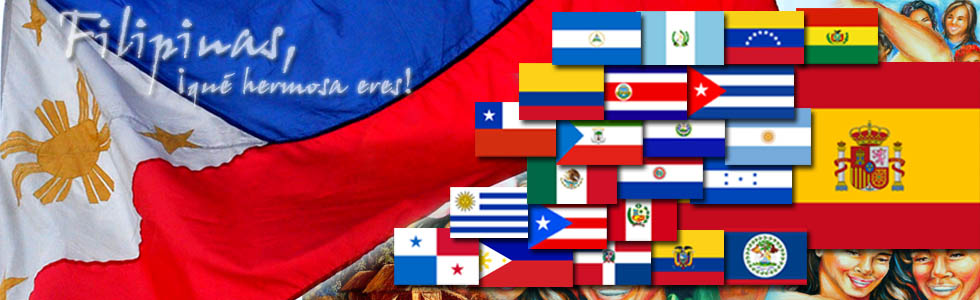
 I made this short composition for the 6th Philippine-Spanish Friendship Day on the 30th of June. I might not be able to do some postings a few days before the celebration. I'm going to be very busy doing His work. Thanks for the burden Lord... Made this JPEG I call it La Unión de Hispanidad hope you like it. These flaglets were from wikimedia.. Check them out by clicking it. ☺
¿Dónde están Las Islas Bonitas?
El orgullo de Rizál...
El orgullo de la raza malaya
Luchamos juntos para tener libertad
¿No compartimos la conciencia de Simón Bolivar?
¿Y los sentimientos del Padre Hidalgo?
¿Por qué te has olvidado las raices que compartimos?
¿Por qué te has olvidado?
Te esperaremos...
La gran comunidad te está esperando ahora.
The Cultural Oblivion
>> 22 June 2009
 ARE FILIPINOS REALLY ASIAN? I should have posted this on our 111th Independence Day. Gee so much fighting in YouTube. Asian in terms of what? Geographical location? The only way to settle this is to read the original Spanish historical accounts! It's just so sad that Filipinos nowadays don't know who they really are. Ignorance. I remember an excursion by my mentor's mentor ignorance is equated to darkness. Darkness is something bad right? The grim. To go back, here's an article by one of the members of Circulo Hispano-Filipino.
ARE FILIPINOS REALLY ASIAN?
Much of the trouble with understanding Philippine identity comes from a lack of historical knowledge. Philippine history texts since the early 1900's have attempted to change Filipinos' own interpretation and understanding of history, particularly that of the colonial period. A number of historical stereotypes about the Spanish colonial period (and Spanish language) were created by the US administration at the beginning of the 20th century, in order to pave the way for American rule. For example: the general Spanish "oppression" , the "abuses of the friars", the "keeping Filipinos ignorant" and "not teaching the Spanish language to the natives", or the "Americans bringing democracy and civilization to the Philippines" . This is just an example of the many stereotypes and historical exaggerations which were taught to the population generation after generation, through revised history texts, to make the new American rulers appear as liberators of the Philippine people. It was a sort of historical propaganda through the national education system, which has taken root in the Philippine conscience ever since. But even nowadays, a century later, a time when information flows rapidly thanks to the internet and TV, Filipinos still believe many of these stereotypes to be true, and still consider the Spanish colonial period to have been basically "terrible".
I will not address any of these stereotypes to avoid making this message endless, but feel free to ask me about any of them, and I'll be happy to explain why they are basically untrue. The question is that these exaggerations about Philippine history, together with important omissions of historical facts, have created a sort of identity crisis, and even a "self-hatred" of Filipinos towards their own cultural roots. The reason is simple: Filipinos are a nation of Hispanic + Austronesian heritage (just like Mexicans are a nation of Hispanic + Aztec or Mayan heritage). But Filipinos have been taught to hate the Hispanic part of their heritage. Even worse, many elements of this Hispanic heritage have been hidden from them. A quick example: most Filipinos think the Spanish language was never spoken by more than 1 or 2% of the population at any given time, whic is untrue: Spanish was the language of trade, education, politics, literature and even the language of everyday life in the big cities like Manila and Cebu. The first Philippine State also chose Spanish as its official language. So by hiding or minimizing these important historical facts, many Filipinos generally think "they are not Hispanic". Plus, they don't speak Spanish and only know "negative" things about the Spanish colonial history. They even consider other Spanish-speaking Filipinos to be snobs or "descendants of the oppressors", which is ridiculous. So with these omissions and negative ideas about their past, the Philippine society has been alienated from its cultural identity.
Which brings us back to the "Are Filipinos really Asian" question. There is obviously no such thing as an "Asian culture". But if we can talk about an "East Asian" or "Oriental" culture, Filipinos are definitely NOT part of it. They stand out in Asia because they are Catholic, they write in the Latin Alphabet, they have Spanish names, they celebrate Easter, they celebrate "barrio fiestas", they have beautiful 17th century churches all over the islands, their traditional music and dances are Hispanic, their traditional clothes are Caribbean (the barong tagalog is a Philippine version of the Latin American guayabera), they eat "adobo", "lechon" and "tortas", they greet each other with a simple handshake (they don't bow, or put their palms together in front of their forehead), they respect the elderly by kissing on the hands or touching their elders' hands on their foreheads, we call it 'Lamano' which is Spanish, La mano (The hand) for Cebuanos it's simply a handshake, their national currency is called "Peso", and their classical literature is in Spanish.
So, if identity is about 1) geography, 2) race, and 3) culture, then the question "Are Filipinos really Asian" is ALL about culture. It is not about geography because the Philippines is obviously in Southeast Asia. It could be about race, but there is no such thing as an "Asian" race. So the question is very much about the culture of Filipinos. And because most people ignore the whole Hispanic element in Philippine culture, is why they cannot understand how Filipinos are so "different". The reason they are different is because the Philippines is an Hispanic-Asian country with many cultural elements common to Latin America. This makes it an outstanding country in terms of culture, as it blends Southeast Asian elements with Chinese, and more recently with Northamerican, all on a centuries-old Hispanic base.
So the answer to the question "Are Filipinos really Asian" is: yes from a geographical point of view, maybe from a racial point of view, but HARDLY from a cultural point of view.
Saludos,
Javier Ruescas
To add up, I personally hate what Spain did to us but I guess being Filipino is loving everything in the Philippines. Not just Hispanic Philippines but also Pre-Hispanic (Lumad & Moro). Hispanicity has nothing to do with Spain anymore but it's a community of nations who had the same fate under the Spanish Empire sharing the same culture and sentiments. A Costa Rican friend said that he hates Spain and what he's thankful of is the culture and the language shared by 340 Million people around the globe.
It was last week that I've discovered the origin of the word, 'Pinoy' and it bears too much prejudice behind this popular term among the Filipinos nowadays. The term was used during the early days of the American colonization of the islands. Just like American-Hispanics being refered as 'Latinos.' After all, they hate being called latino. Here, the term taga-Mindanao for the ones living in the northern part of the archipelago bears a negative stereotype, prejudice. It goes like that with the latinos, chinks (chinese), the japs etc. Pinoy came from two words, and you won't like the latter. From now on, I recommend that you call yourselves Filipino/Pilipino. I told my companions not to use it anymore and we agreed to teach their siblings, the young ones. Look on the dimensions and not the superficial. This posting does not promote any grudge or whatever to anyone but it's time to know the truth behind the twist and turns of Philippine history. Lets blame ourselves for being too nostalgic of something or from gringolandia and look after our ever-beloved 7,107 islands. ☺
Subscribe to:
Posts (Atom)


